

NVIDIA Stock Analysis: A Comprehensive Overview
NVIDIA Corporation, a leading name in the semiconductor industry, has been at the forefront of technological innovation for decades. Known primarily for its graphics processing units (GPUs), NVIDIA has expanded its portfolio into artificial intelligence (AI), data centers, autonomous vehicles, and gaming. The company’s stock has seen phenomenal growth, making it one of the most talked-about stocks in the technology sector. This article provides an in-depth analysis of NVIDIA’s stock, covering its financial performance, market trends, competitive positioning, and future outlook.
Overview of NVIDIA Corporation
Founded in 1993 by Jensen Huang, Chris Malachowsky, and Curtis Priem, NVIDIA began as a graphics chip company catering to the gaming industry. Over the years, it has diversified into numerous high-growth industries. NVIDIA’s GPUs are renowned for their performance and have become the industry standard for gaming, AI, and professional visualization.
In recent years, NVIDIA’s focus on AI has propelled it into the spotlight. Its GPUs are critical in training machine learning models, making it a cornerstone for companies and institutions working on AI research. Additionally, NVIDIA’s acquisition of Mellanox Technologies in 2020 bolstered its presence in the data center market.
NVIDIA Stock Performance
Historical Growth
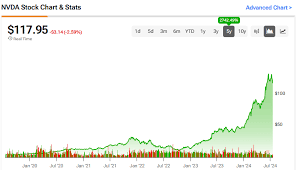
NVIDIA’s stock has been a stellar performer, particularly in the last decade. In 2013, NVIDIA’s stock price hovered around $14. Fast forward to 2023, and the stock has crossed the $400 mark, marking a growth of over 2,800%. This meteoric rise can be attributed to its dominance in the GPU market, strategic acquisitions, and early bets on AI and data centers.
Stock Splits
NVIDIA has executed several stock splits to make its shares more accessible to retail investors. The most recent split occurred in July 2021, with a 4-for-1 ratio. Such splits have contributed to increased liquidity and broader ownership.
Market Capitalization
As of 2023, NVIDIA’s market capitalization exceeds $1 trillion, making it one of the few companies globally to achieve this milestone. This underscores its dominance and investor confidence in its long-term growth prospects.
Financial Performance
Revenue Growth
NVIDIA has consistently delivered robust revenue growth. In fiscal 2023, the company reported revenues of $26.97 billion, a 61% increase compared to the previous year. This growth was primarily driven by strong demand for GPUs in gaming and data center segments.
Profitability
The company’s profitability metrics are equally impressive. NVIDIA’s net income for fiscal 2023 stood at $9.75 billion, translating to a net profit margin of approximately 36%. This highlights the company’s operational efficiency and strong pricing power.
Earnings Per Share (EPS)
NVIDIA’s EPS has also seen significant growth, driven by rising revenues and efficient cost management. The diluted EPS for fiscal 2023 was $3.82, up from $2.65 in the previous year.
Key Growth Drivers
1. Artificial Intelligence (AI)
AI is arguably the most significant growth driver for NVIDIA. The company’s GPUs are critical for training and deploying AI models. NVIDIA’s CUDA platform has become the go-to solution for AI researchers and developers worldwide. With the increasing adoption of AI across industries, NVIDIA stands to benefit immensely.
2. Data Centers
The data center segment is another major revenue contributor. NVIDIA’s GPUs are widely used in cloud computing, enabling high-performance computing (HPC) and AI workloads. The acquisition of Mellanox has further strengthened its position in this market.
3. Gaming
While AI and data centers are the primary growth engines, gaming remains a crucial segment for NVIDIA. The company’s GeForce GPUs are the preferred choice for gamers, offering unmatched performance. The launch of the GeForce RTX series has further cemented its leadership in the gaming market.
4. Automotive
NVIDIA is also making strides in the automotive industry with its DRIVE platform, which provides hardware and software solutions for autonomous vehicles. While this segment is still in its early stages, it has immense growth potential.
5. Omniverse and Professional Visualization
The NVIDIA Omniverse platform is another promising area. It enables 3D simulation and collaboration, targeting industries like architecture, media, and entertainment. As the metaverse concept gains traction, Omniverse could become a significant growth driver.
Competitive Landscape
NVIDIA operates in a highly competitive industry, facing challenges from companies like AMD, Intel, and Qualcomm. Despite this, it has maintained its leadership position due to its technological edge and robust ecosystem.
Strengths
- Technological Leadership:* NVIDIA’s GPUs are unmatched in performance, giving it a competitive edge.*
- Strong Ecosystem:* The CUDA platform and developer community create significant barriers to entry for competitors.*
- Diverse Revenue Streams:* NVIDIA’s presence across multiple high-growth industries mitigates risks.*
Challenges
- High Valuation:* NVIDIA’s high stock valuation could deter some investors.*
- Regulatory Risks:* The semiconductor industry is subject to strict regulations, which could pose challenges.*
- Supply Chain Issues:* Like other tech companies, NVIDIA has faced supply chain disruptions, affecting its ability to meet demand.*
Future Outlook
Short-Term Prospects
In the near term, NVIDIA is expected to benefit from strong demand for its GPUs in AI and gaming. The company’s focus on innovation and its robust product pipeline position it well for continued growth.
Long-Term Growth
Over the long term, NVIDIA’s prospects look even brighter. The increasing adoption of AI, the growth of cloud computing, and advancements in autonomous vehicles are all tailwinds. Additionally, the company’s investments in the Omniverse platform and quantum computing could unlock new revenue streams.
Analyst Projections
Analysts remain bullish on NVIDIA. Many have set price targets above $500, reflecting their confidence in the company’s growth potential. However, they also caution that the stock’s high valuation makes it susceptible to volatility.
Risks and Challenges
Despite its strong fundamentals, NVIDIA faces several risks:
- Market Volatility:* High-growth tech stocks like NVIDIA are often subject to significant price swings.*
- Competition:* Companies like AMD and Intel are continuously working to narrow the gap in GPU performance.*
- Geopolitical Risks:* As a global company, NVIDIA is exposed to geopolitical tensions, particularly between the U.S. and China.*
- Economic Uncertainty:* Macroeconomic factors, such as inflation and interest rate hikes, could impact consumer spending and corporate investments.*
Should You Invest in NVIDIA Stock?
Reasons to Buy
- Strong Growth Potential:* NVIDIA is a leader in multiple high-growth industries.*
- Technological Edge:* Its GPUs and AI platforms are industry benchmarks.*
- Robust Financials:* The company’s strong revenue growth and profitability make it a solid investment.*
Reasons to Hold or Avoid
- High Valuation:* The stock’s high P/E ratio could be a concern for value investors.*
- Market Risks:* As a high-growth stock, it is more susceptible to market downturns.*
Conclusion
NVIDIA’s stock is a compelling investment opportunity for those looking to capitalize on the growth of AI, gaming, and data centers. While the high valuation and market risks cannot be ignored, the company’s strong fundamentals and leadership position make it a long-term winner. As with any investment, potential investors should conduct thorough research and consider their risk toler

Leave a Reply