

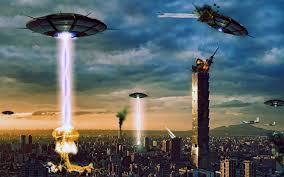
Alien Invasion: The Biggest Event of 2025
Breaking News: First Encounter with Extraterrestrial Beings in 2025 Shocks the World
The year 2025 began with a historical event that has reshaped humanity’s understanding of life beyond Earth. Extraterrestrial beings—commonly referred to as aliens—made their presence known in an astonishing series of events that captivated global audiences. Here’s a detailed account of how these encounters unfolded and what they mean for the future of our planet.
Discovery of Unidentified Aerial Phenomena (UAPs)
On January 3, 2025, several countries reported mysterious lights in the sky over key locations. Eyewitnesses in New York, Beijing, and Sydney described seeing enormous, saucer-shaped crafts that hovered silently before vanishing at incredible speeds. Initially dismissed as advanced drones or weather phenomena, the sightings were soon confirmed by multiple military agencies.
In a public statement, NASA Director Dr. Emily Harris said, “This is unlike anything we have encountered. The technology observed defies our current understanding of physics.” The United Nations called an emergency session to address the implications of these sightings.
The First Contact: March 15, 2025
The world held its breath on March 15 when a spacecraft landed near the Great Pyramid of Giza. The triangular craft, approximately 100 meters wide, emitted a soft, blue glow. Crowds gathered as authorities cordoned off the area. Unlike cinematic portrayals, no dramatic ramp or hostile invasion followed.
A group of humanoid beings emerged, standing about eight feet tall with translucent, bluish skin. They communicated through gestures and emitted harmonic sounds that were later analyzed as a complex language. Linguistic experts, using advanced AI, began the painstaking task of deciphering their messages.
Global Reactions to Extraterrestrial Beings

Political and Diplomatic Responses
Governments reacted with a mix of caution and diplomacy. The President of the United States, in a televised address, urged calm and cooperation, stating, “We must embrace this moment with curiosity and unity, not fear. Humanity stands at the threshold of a new chapter.” Similarly, leaders from China, Russia, and the European Union emphasized the importance of peaceful dialogue.
However, not all responses were measured. Several fringe groups, fueled by fear and conspiracy theories, staged protests against the “alien threat.” In some regions, panic led to mass evacuations and stockpiling of resources. Social media buzzed with theories, from doomsday predictions to hopes of technological miracles.
Scientific Community: A Dream Realized
For the scientific community, the arrival of extraterrestrial beings was a long-anticipated milestone. Dr. Arjun Mehta, an astrophysicist at the Indian Space Research Organisation (ISRO), remarked, “This is the moment we have been waiting for. We now have the opportunity to exchange knowledge and unravel the mysteries of the universe.”
Scientific teams from around the world collaborated to study the visitors’ biology, technology, and communication methods. Early findings revealed that their ships utilized a form of propulsion that manipulated gravitational fields, a concept theorized but never before observed in practice.
Communication Breakthrough
By mid-June, breakthroughs in deciphering the alien language allowed for basic communication. The extraterrestrials identified themselves as emissaries from a distant star system in the Andromeda galaxy. They referred to their species as the “Zorathians.” Their mission was one of exploration and peaceful cultural exchange.
A statement translated from Zorathian glyphs read: “We seek harmony and shared understanding. Our journey across the stars is driven by a desire to learn and to offer knowledge that will benefit all sentient beings.”
The Zorathians provided detailed star maps and shared information about advanced technologies related to clean energy, medical advancements, and interstellar travel. Their technology hinted at solutions to Earth’s most pressing problems, including climate change and sustainable resource management.
Cultural Impact and Human Imagination
Art, Media, and Pop Culture
The alien encounter immediately influenced popular culture. Films, music, and literature began reflecting humanity’s newfound relationship with the cosmos. Directors rushed to produce movies inspired by real-life events, and musicians created symphonies based on the harmonic sounds of the Zorathians.
Memes and internet humor also surged. One popular meme depicted a Zorathian attempting to understand human fast-food drive-throughs, humorously highlighting cultural differences.
Religious and Philosophical Questions
Theological debates reignited as religious communities pondered the spiritual implications of extraterrestrial life. Some saw the aliens’ arrival as evidence of divine creation’s vastness, while others questioned long-held beliefs about humanity’s unique place in the universe.
Philosophers discussed ethical considerations: How should humanity treat beings from other worlds? What responsibilities do humans have when sharing knowledge or resources with advanced civilizations? These questions sparked international forums and symposiums.
Challenges and Tensions
Despite the general tone of cooperation, tensions simmered beneath the surface. The militarization of alien technology became a contentious issue. Some nations argued for defensive preparedness, fearing potential threats, while others advocated for transparency and shared research.
The mysterious disappearance of a Zorathian emissary in July raised suspicions and fueled conspiracy theories. Was it an accident, a kidnapping, or an act of sabotage? Investigations involving both human and Zorathian representatives were launched, but no definitive answers emerged.
The Road Ahead: Unity or Division?
As the year progresses, the future of human-alien relations remains uncertain. The United Nations established a dedicated committee, the Extraterrestrial Relations Council (ERC), to oversee diplomacy and manage shared projects. Efforts are underway to create a universal code of ethics for interspecies interactions.
The lessons of 2025 remind humanity of its resilience and capacity for wonder. The question remains: Will Earth rise to the challenge of cooperation and unity, or will fear and mistrust dictate the path forward? Only time will tell.
As history unfolds, one truth is undeniable—the cosmos has become a little less lonely, and humanity’s place in it has been forever transformed.

Leave a Reply